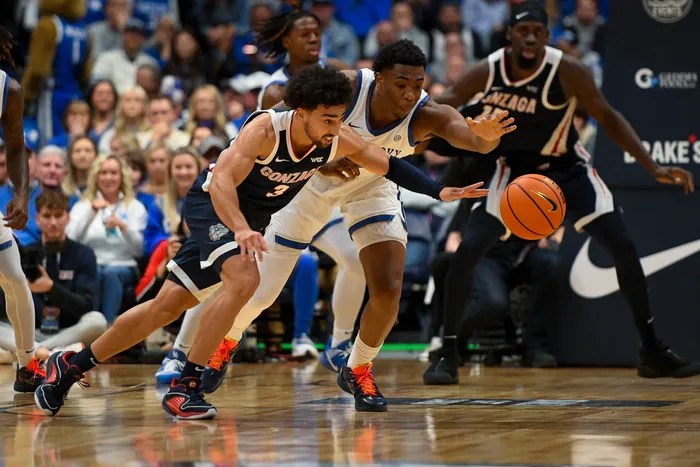
Kentucky fans filed out of Bridgestone Arena on Friday, Dec. 5 filled with disappointment and anger following Gonzaga’s 94-59 dismantling of the Wildcats. The roster rumored to be constructed on the backs of $22 million in NIL funds was seemingly nowhere near the national title aspirations imagined at the onset of the 2025-26 season. Harsh criticism of second-year head coach Mark Pope reverberated across social media platforms and cries for Calipari awakened in the desperate voices of Big Blue Nation.
458 miles south, Alabama fans were experiencing similar, yet drastically less intense, feelings about the Crimson Tide and its head coach. Two seasons removed from the first Final Four appearance in school history, fans were uneasy about the team Nate Oats had assembled, with these feelings piquing on Feb. 1.
That afternoon, Alabama surrendered 100 points to Florida, falling to 14-7 with a 4-4 record in SEC play. Coupled with the discourse surrounding the Tide’s plummeting record was the ongoing Charles Bediako saga – which saw the former G-League player return to the Tide for five contests due to a temporary restraining order. Fans became exhausted by the off-the-court noise and uninspired by the on-the-court play. Patience had begun to run thin in Tuscaloosa.
In Cincinnati, fans may have preemptively begun discussions of their next head coach following the Bearcats 59-54 home loss to West Virginia on Thursday, Feb. 5. Wes Miller was videoed publicly apologizing to a group of fans following the performance, seemingly marking the end of his tenure in Cincinnati. The Bearcats had amassed an 11-12 record and were destined to miss out on the Big Dance for the seventh consecutive season.
Since each team’s culminating losses sent its fanbases into a spiral, they have all responded fiercely, quieting the voices that once ridiculed them.
Currently, Kentucky owns a 19-11 record and could finish as high as a five seed in the NCAA Tournament. While the Wildcats aren’t quite in the national title conversation, the season hasn’t been as dreadful as it was once made out to be. One could actually argue Pope has responded impressively throughout the season, as they continually suffered tough losses and lost key pieces Jayden Quaintace, Jaland Lowe and Kam Williams for indefinite stretches due to injury.
Alabama responded from its drubbing in Gainesville by rattling off eight consecutive wins, highlighted by a double-overtime win against Arkansas and a come-from-behind victory over Tennessee on the road. The Tide are currently projected to be a four seed in the tournament and reside as an under-the-radar Final Four pick.
The Bearcats – who have orchestrated one of the more improbable turnarounds in recent history – have earned wins in six of their last seven games and are on the doorstep of an at-large berth. Since their loss to the Mountaineers, they are rated as the fifth-best team in the nation by Bart Torvik. With a win against TCU on Saturday, Cincinnati could enter the tournament as a feared 11-seed.
All three of these teams faced heavy criticism throughout different stretches of its season. In the age of NIL, where a 15-16-man roster can garner upwards of $20 million, public critique of a team’s play naturally increases. It’s the unexpected baggage of earning millions as a college athlete.
While the payment of players may weaken a fanbase’s patience, there is a stronger argument that the current landscape actually calls for an extended period of grace.
Each season, there is increased roster turnover. Coaches are scrambling to find players that fit their system and will mesh with the new roster they are creating. This constant level of uncertainty makes the job of a college coach more difficult than ever.
In an age where every result is magnified due to the financial commitments made to each team, it is more important than ever to exercise patience. It takes time and reps for teams to build the proper chemistry required to be successful in college basketball.
Every game on the schedule is important, but the games that define a team’s season begin in February and March – certainly not after a neutral site contest in December.
All three of these teams – Kentucky, Alabama and Cincinnati – have weathered the storm and now have their eyes set on March, serving as a testament to the importance of being patient with teams in the new age of NIL.
 Power Five Press