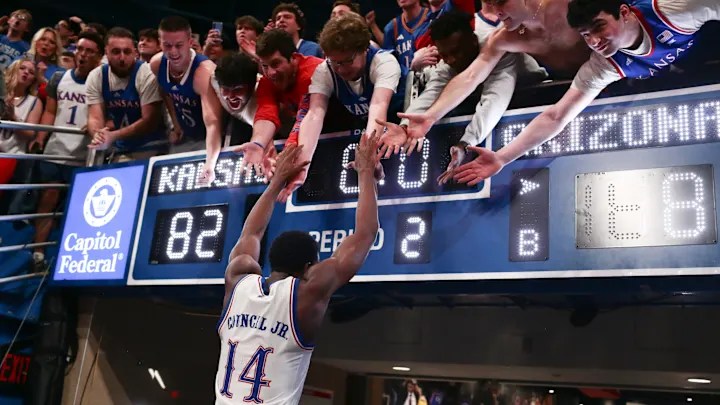
The 2025-26 college basketball season is being touted as one of the best in the sport’s history. From outstanding undefeated seasons to arguably the most talented freshman class ever, each night seemingly delivers better than the last.
Two nights ago, on Feb. 9, Kansas moved to 40-0 on ESPN’s Big Monday at Allen Fieldhouse under Bill Self, as the Jayhawks ended No. 1 ranked Arizona’s undefeated season. Over the weekend, Duke and North Carolina added another classic chapter to their storied rivalry, with Seth Trimble shocking the Blue Devils at the (almost) buzzer.
Each performance and storyline adds buzz to a sport that some began to worry about as we transitioned into the new era of college sports.
With the introduction of NIL and the rampant use of the transfer portal, a palpable shift was felt across college basketball. Regular, four-year starters that previously defined programs were hard to find, and each season delivered rosters littered with new faces.
However, the NIL era of college basketball may be the catalyst behind one of the greatest seasons the sport has ever seen. Despite the grudges held against paying players and the messiness that accompanies it, the energy it has brought to the sport should be celebrated as well.
College basketball has segued into the pay-for-play era, and in turn, the talent level within the sport has increased. Now, players are searching for ways to enter or remain in college basketball, instead of pursuing other avenues that yield compensation.
This past offseason, we saw UAB forward Yaxel Lendeborg choose to return to college and transfer to Michigan instead of entering the NBA Draft, where he was a presumed late first-rounder. Now, the New Jersey native is one of the primary reasons the Wolverines sit 22-1 and have earned their best start in program history.
In Tuscaloosa, Labaron Philon Jr. had similar NBA interest to Lendeborg following his freshman campaign. However, the talented guard opted to return to Alabama, where he is now averaging 21.5 points per game for Nate Oats’ squad.
These are just two examples of stars in college basketball opting to return to college basketball, likely due to the newfound financial opportunities.
Yet, the talent level is not only being increased by players opting to return to college. Due to the lack of parameters over who is truly eligible for college athletics, there is also an influx of overseas players who have enrolled in the sport as well.
At the University of Virginia, 23-year old freshman Thjis De Ridder leads the No. 15 ranked Hoos in scoring with 16.1 points per game. De Ridder played professionally in Belgium prior to his time in Charlottesville, Va.
In Champaign, Ill., Brad Underwood’s team is filled with European talent. The No. 8 ranked Illini have relied heavily upon former professionals as they pursue the program’s first national title.
These programs are not the two taking advantage of the newfound eligibility. Duke recruited Dame Sarr, Gonzaga brought in Mario Saint-Supery and Virginia Tech added Neoklis Avdalas to its roster, all of whom played professionally overseas prior to their time in college basketball.
International sports agent Misko Raznatovic told the Associated Press that “players get offers 10 times higher than in Europe,” to come play college basketball. When the financial difference is that drastic, players will understandably listen. As a result, the talent level in college basketball has risen.
While high-level players returning to college and the growing European influence across the sport have expanded the talent pool, the biggest story this season has been the otherworldly freshman class.
Whether it is AJ Dybantsa at BYU, Darryn Peterson at Kansas, Cameron Boozer with Duke or any of the other freshman that provide highlight-after-highlight, it is hard to argue that another class has provided as much excitement and entertainment as the current group.
Talented freshman have entered college since the one-and-done rule was implemented prior to the 2006 NBA Draft. However, in recent seasons, some top high school recruits have opted for professional opportunities that offered compensation rather than playing college basketball.
In 2024, lottery picks Ron Holland and Matas Buzelis both played for the G League Ignite prior to entering the NBA Draft. The season before, the high-flying Thompson twins, Amen and Ausar, opted to play for Overtime Elite instead of pursuing college opportunities.
Now, all of the top high school talent is choosing to enter college, seemingly due to the paycheck that comes with their enrollment. In the 2025 NBA Draft, the top 10 picks were all college athletes. In the upcoming 2026 NBA Draft, almost all of the projected first-round picks are playing college basketball.
Having college basketball stand out as the cut-and-dry best option for young, talented players is a critical development for the sport. As seen this season, the hype surrounding college basketball reaches its peak when the game is flooded with talented freshmen.
The belief that this season is one of the sport’s best is also supported by the increased viewership. FOX reported to Front Office Sports that as of Feb. 5, the average viewership for games broadcasted on its channels has increased by 69%.
This season, college basketball took center stage on Black Friday, as the two showcase matchups – Arkansas vs. Duke and Michigan State vs. North Carolina – drew 6.8 million and 6.5 million viewers, respectively. The 6.8 million viewers for Arkansas vs. Duke was the most watched regular season game in 30 seasons.
FS1 recently had its most watched college basketball game of the channel’s 13-year history when Illinois and Nebraska faced off, drawing in 1.37 million viewers. Further, FOX aired its fifth-most-watched game ever when in-state rivals Michigan and Michigan State met on Friday, Jan. 30, with 2.76 million viewers tuning in to watch the Wolverines defeat Sparty.
Each weekend seemingly shatters a previously held viewership record, a clear sign that the masses are tantalized by the current state of the sport.
Despite the surge of talent and the uptick in viewership, the cynics may turn their head in disgust at the new era of college basketball. Some view the year-to-year roster turnover as disgraceful. Others cannot comprehend how much some athletes are being compensated for one season of basketball.
And while the sport is imperfect, the focus should be on the product of the games. So, ditch the nostalgia and grievances and enjoy what is potentially the best season of college basketball ever. It will all come to a screeching halt before you know it.
 Power Five Press